Designing access to a bird's-eye view
Consolidated View gives multi-company businesses one place to work across their organization. I led the product-design work for how employees and accounting partners gain access to that enterprise-wide experience.
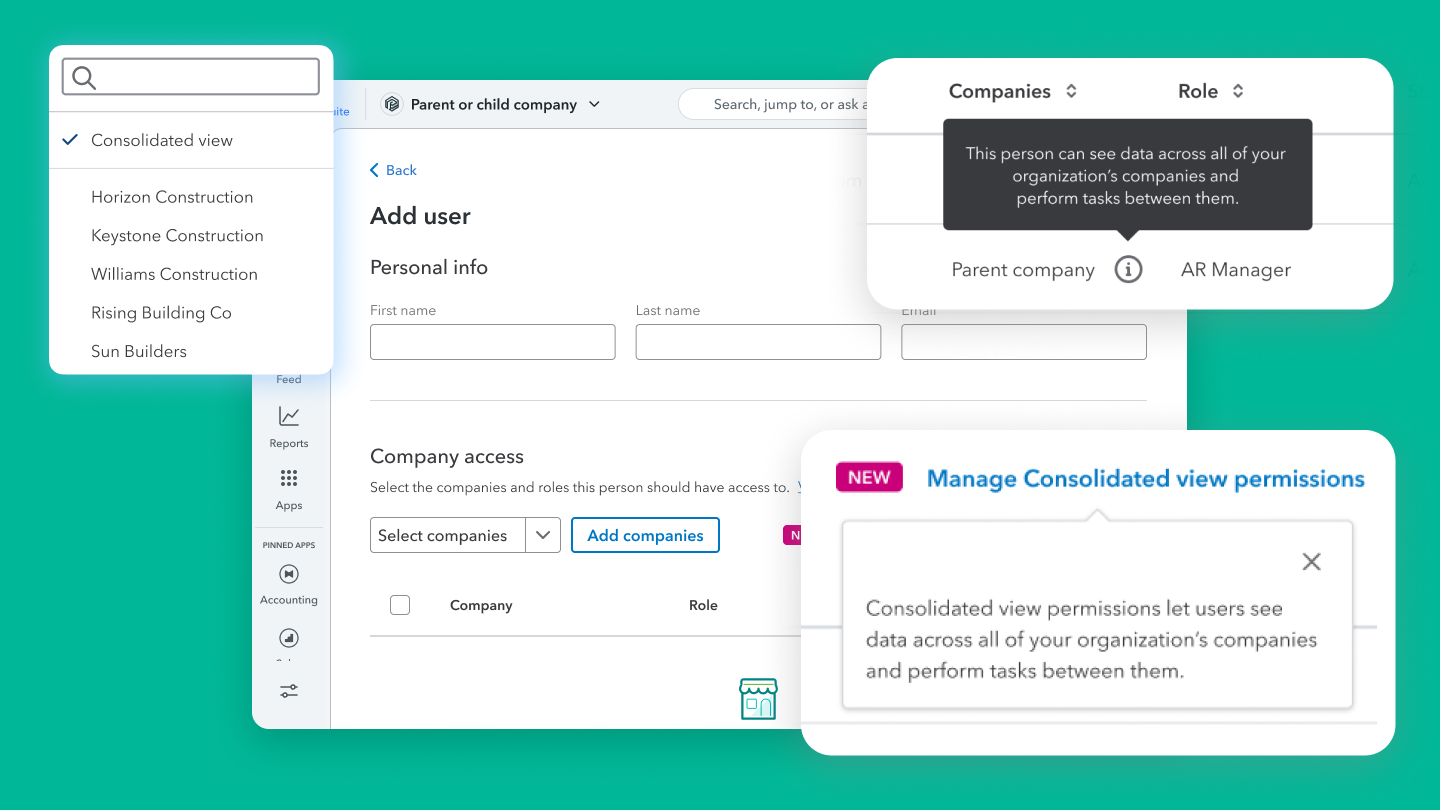
A bird's-eye view of the business also changes what "access" has to mean.
Intuit Enterprise Suite customers operate as multiple related companies, and their most important financial work — comparing performance, managing intercompany activity, reporting on the whole group — cuts across all of them. But the product was organized company by company, so finance teams pieced together the bigger picture by hand. Intuit introduced Consolidated View to fix that: one workspace to see and manage the whole organization at once.
That raised a new question none of the existing controls answered: who should be able to see and act across the entire business, not just one company inside it?
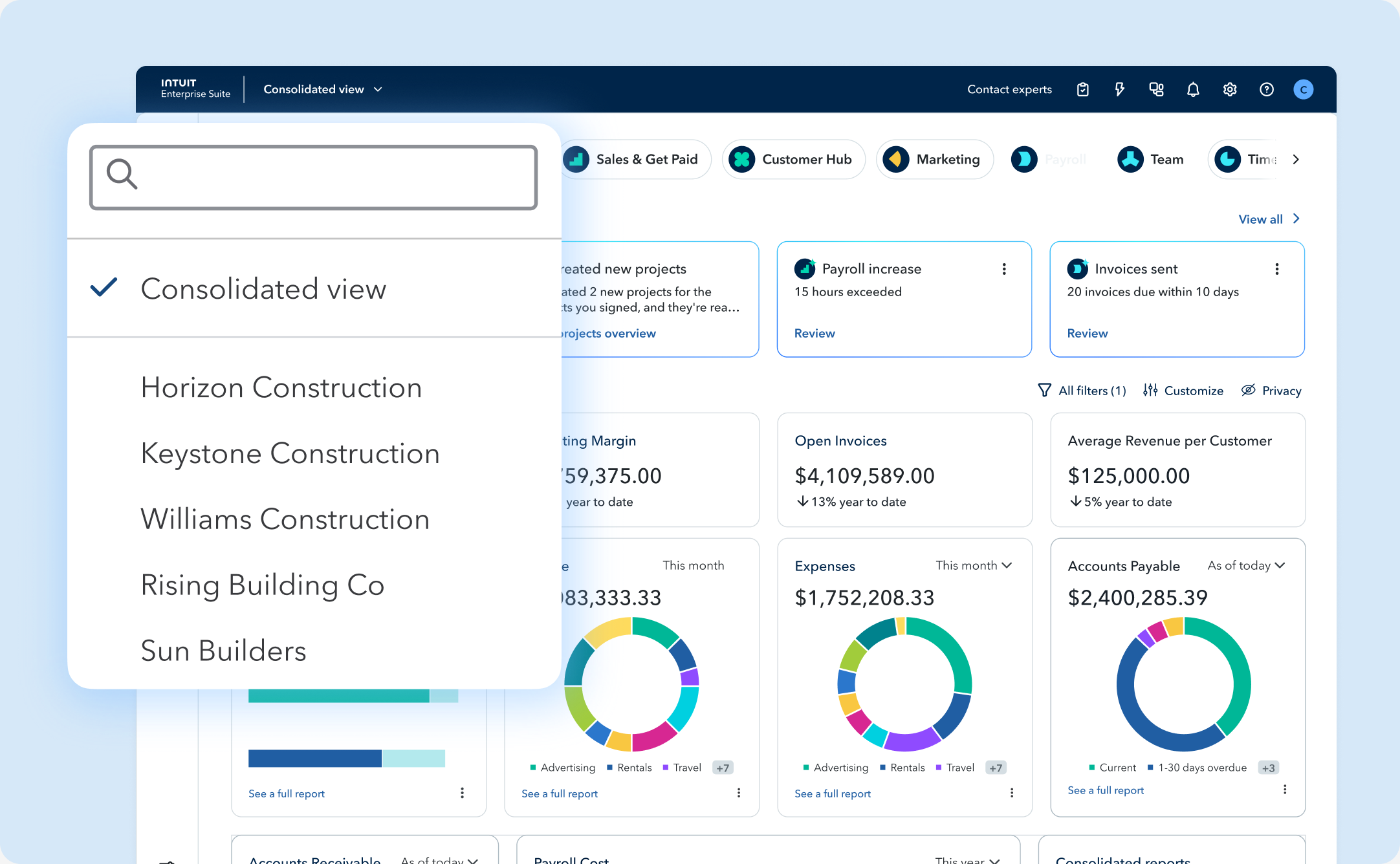 One enterprise view across multiple companies.
The destination made sense. The access model didn't.
Research with administrators and accountants showed people understood Consolidated View itself immediately — a bird's-eye view of the business was an easy idea to grasp. The permission model behind it wasn't. Technical language describing access scope left people unsure whether they were granting a few companies or the entire organization.
So we shifted the design toward what customers were trying to accomplish, not how access was implemented underneath — anchoring the interface in Consolidated View permissions and spelling out exactly what they covered, rather than exposing the underlying model.
One access model, two very different audiences.
For internal finance teams, administrators needed a way to grant the cross-company capabilities in Consolidated View without mixing that decision into everyday company access. We gave Consolidated View its own dedicated place in user management — a focused answer to one question, instead of one confusing answer to two.

Accounting firms needed another level of delegation entirely. A firm might serve several clients, each operating many companies, with access authorized for only some of them — so the model had to add a second link in the chain: the client business controls its relationship with the firm, and the firm's own administrator controls which of its staff can use Consolidated View. The product enforces the boundary between them.
 The client owns the relationship with the firm. The firm manages delegation to its own people.
From one dashboard to a scalable way to share responsibility.
Consolidated View and broader team access shipped publicly as part of the Intuit Enterprise Suite Fall 2025 release.
In enterprise software, access is part of the experience — not a layer added afterward. The product has to make scope, responsibility, and boundaries understandable to the people doing the work.
I led the product-design work for identity, access, and permissions within Consolidated View, from the internal finance-team experience through its extension to accounting firms. I partnered with product, engineering, research, analytics, and platform teams to translate complex access models into understandable customer workflows.
Curious about the details behind this?
Happy to walk through the research, the alternatives I ruled out, or how this connects to the wider identity platform work.