Creating one trusted business profile
Reducing repeated data entry and fragmented profile management across products. Customers often interact with multiple Intuit products, but shared business information wasn't always managed as one coherent profile — I helped investigate how a more unified model could reduce repeated data entry and make shared information easier to understand and maintain.
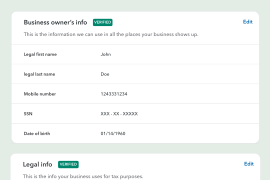
If I update it here, where else do I need to update it?
Customers often use more than one Intuit product to run their business. But the information that identifies that business — its name, address, and other core details — wasn't always managed as one coherent profile. The same information could appear in different onboarding flows and settings experiences, sometimes with different labels or interaction patterns.
In some cases, customers were forced to re-enter information they had already provided elsewhere, or search through multiple settings areas just to figure out which version was current.
“When you do a change of address of the business, it is very difficult to figure out how to update the address for the business itself. It took me months to realize I hadn't updated the address in all the right places. Now I'm facing a situation where we might owe an IRS penalty and have shared the wrong address with customers.”
“I tried to update the company address within the system, which did change, but the paystubs did not reflect the change. If there was a way to prompt us to update primary work locations after we've made company-address changes, that would be very helpful — we wouldn't miss it next time.”
The problem wasn't one broken screen. It was an accumulation.
I started by auditing how shared business information appeared across onboarding and profile-management experiences. Each individual experience made sense within its own product. Together, they created an inconsistent system.
Not "redesign this page" — "what should be shared?"
The design question became larger than how to redesign one profile page. Instead: what information should customers provide once, and how should the rest of the ecosystem reuse it? That led to an important distinction — some information describes the business itself and should stay consistent everywhere the customer encounters it; other information exists only because a particular product needs it.
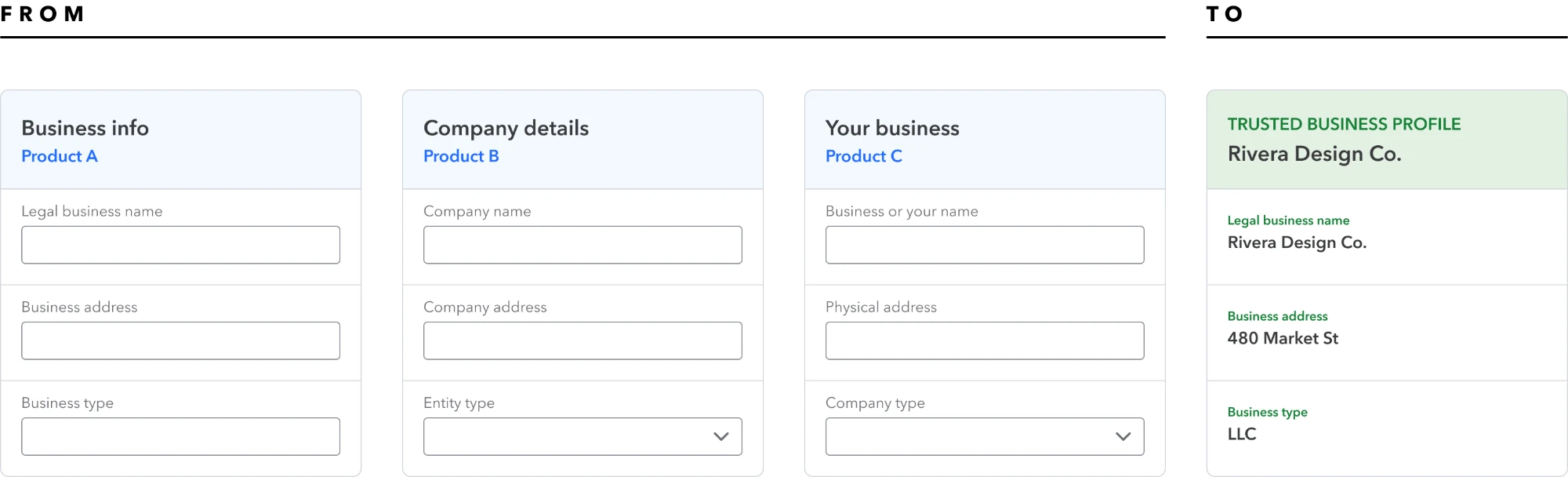
Shared profile information — collected and managed as one trusted business profile. Product-specific information — collected only when the individual product needs it. Not all information should be centralized; separating these two concepts reduced the need for every product to independently ask for and manage the same thing.
Enter it once. Update it in one place. Reuse it everywhere.
We explored how customers could manage shared business information from a more consistent experience rather than maintaining different versions across products — built around three principles: enter it once, avoiding asking customers for information they've already provided; update it in one understandable place, giving customers a clear source for managing shared details; and reuse it wherever it's needed, letting product experiences use trusted profile information instead of creating another disconnected copy.
Unification didn't mean making every product identical. It meant creating consistency where customers expected consistency.
At ecosystem scale, a settings problem becomes a trust problem.
Customers shouldn't have to understand how different products store their information to know whether changing a business detail will produce the outcome they expect. This work helped establish a clearer cross-product direction — one business, one trusted profile, reused across experiences — and gave product teams a stronger foundation for future onboarding and profile-management work without every experience having to solve the same problem independently.
Platform design often begins with something that looks like a UI inconsistency. The deeper issue is frequently ownership. When several products independently collect and manage the same information, improving one screen doesn't resolve the underlying fragmentation — the bigger design opportunity is defining what should be shared, what should remain product-specific, and where customers should feel ownership of that information.
I led product-design work across the profile-unification effort, including cross-product UX auditing, problem framing, experience exploration, and the direction for more centralized profile management. I partnered with product, engineering, research, analytics, content, and designers across multiple product areas to translate fragmented product requirements into a more coherent customer model.
Curious about the details behind this?
Happy to walk through the research, the alternatives I ruled out, or how this connects to the wider identity platform work.