From customer assistant to banker copilot
Extending a conversational banking model from customer self-service into the banker workflow. U.S. Bank had already introduced conversational banking for customers — I explored how that same interaction model could support bankers: helping them find relevant information, understand a customer's situation, and move into the next supported action without leaving their servicing workflow.
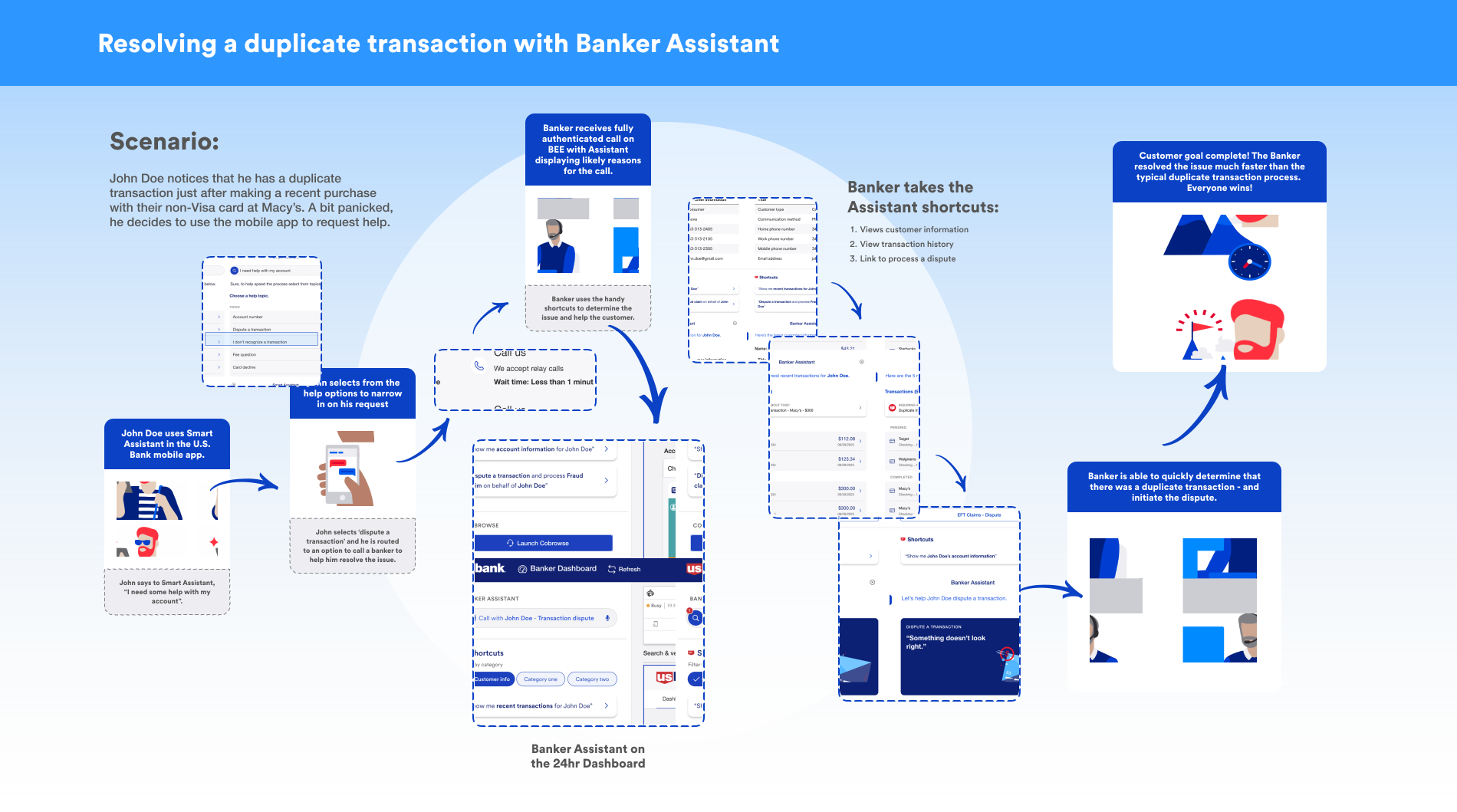
The interaction stayed conversational. The responsibility of the user changed.
U.S. Bank introduced Smart Assistant as a conversational banking experience for customers — letting people ask questions naturally and complete supported banking tasks without navigating traditional menus. U.S. Bank had already established that conversational model for customer self-service. My work explored how that same interaction model could be adapted for the banker helping the customer.
A customer says "I need help with my account," and the customer assistant helps them find information or complete a supported task. A banker's job is different: "I am helping this customer understand what is happening and what we should do next." The banker assistant needed to surface relevant context, help explain the situation, and move toward an appropriate workflow — for someone acting on behalf of another person, working with more context, bringing professional judgment, and responsible for consequential servicing actions.
Search. Learn. Do.
The assistant was designed to move naturally between these modes rather than behave as a separate search destination or a generic chatbot.
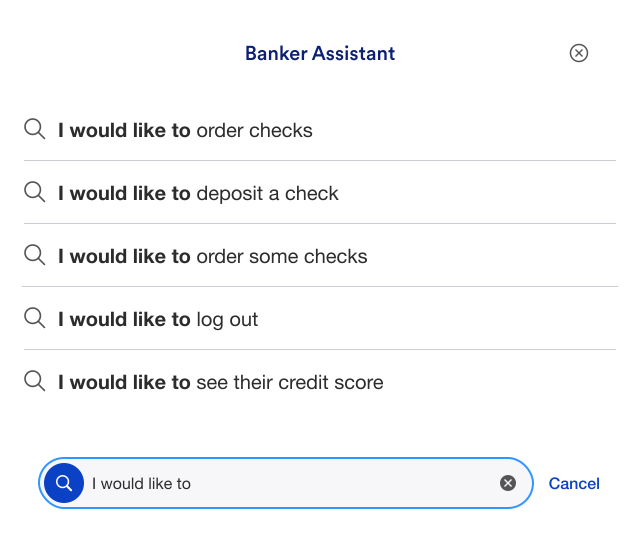 Search — find relevant customer, account, transaction, or product information.
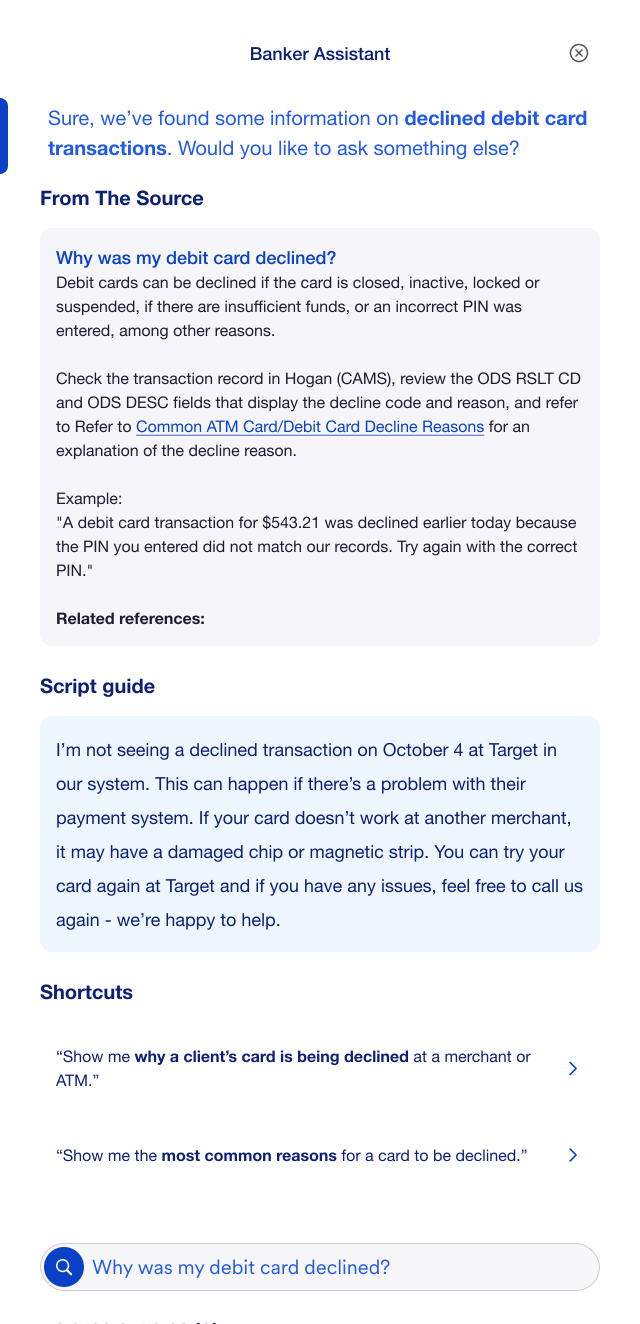 Learn — understand what that information means for the customer's situation.
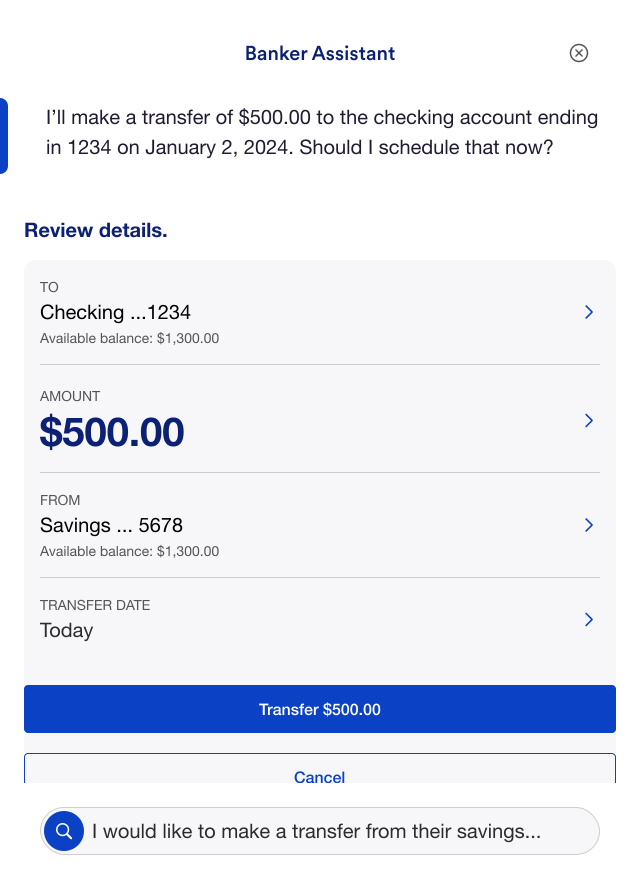 Do — move into an appropriate, supported servicing workflow.
Bring the answer into the workspace, not the other way around.
One of the biggest differences from consumer AI was that the banker was already servicing a specific customer. The assistant needed to use the customer and account context already open in the workspace, instead of forcing the banker to repeatedly search for the same information — reducing context switching without replacing banker expertise.
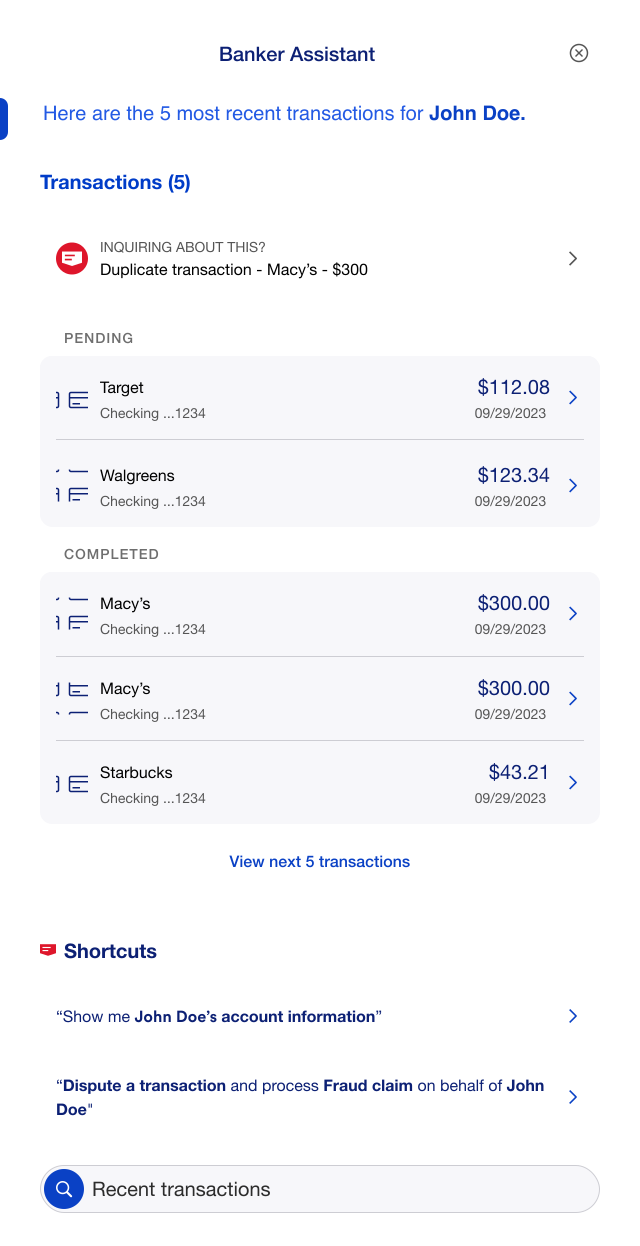 The assistant doesn't just list transactions — it surfaces what's worth the banker's attention, like a likely duplicate charge.
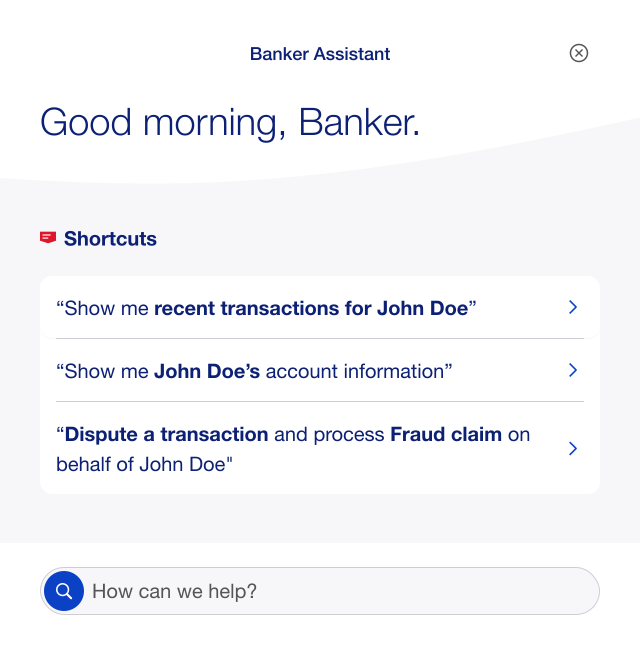 Suggested shortcuts are scoped to the customer already open, not a generic list of everything the assistant can do.
The conversation didn't bypass the controls. It became a guided layer around them.
The most important part of the concept was one representative guided-action workflow — a banker expressing what the customer needed, with the assistant using existing customer and account context, presenting valid choices when a decision was required, summarizing what was about to happen, and requiring the banker's explicit approval before anything consequential occurred.
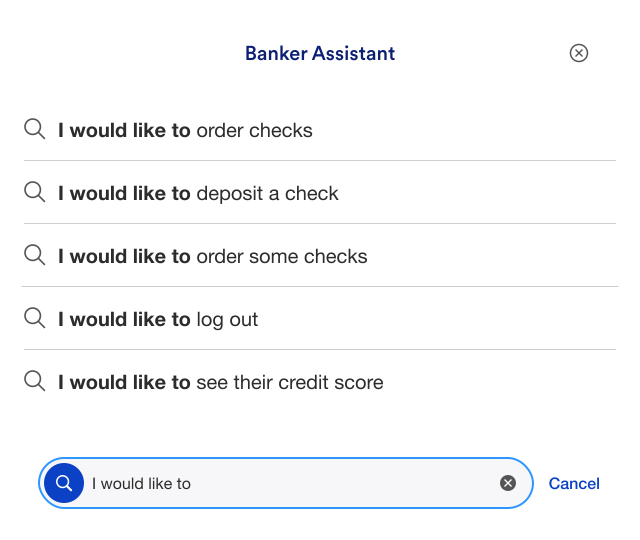 Request — the banker expresses the customer's intended action.
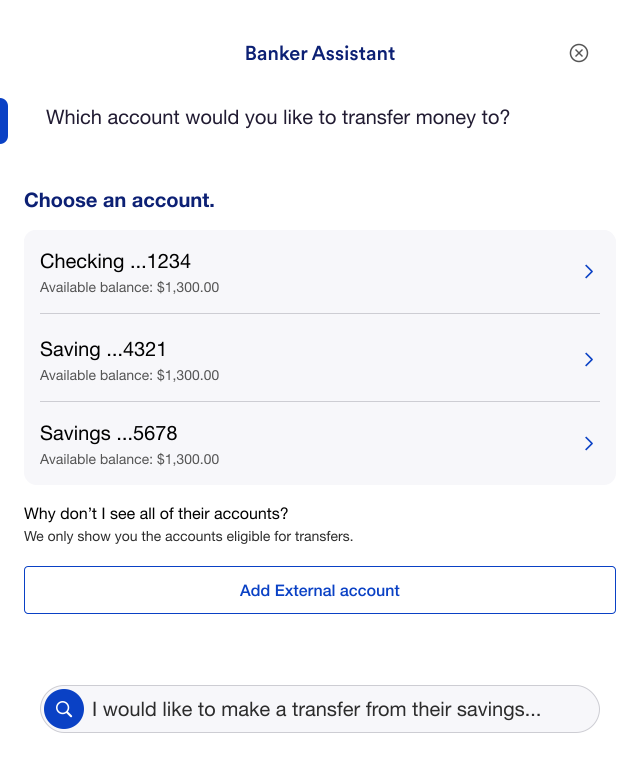 Eligible options — the assistant presents only the valid choices for this customer.
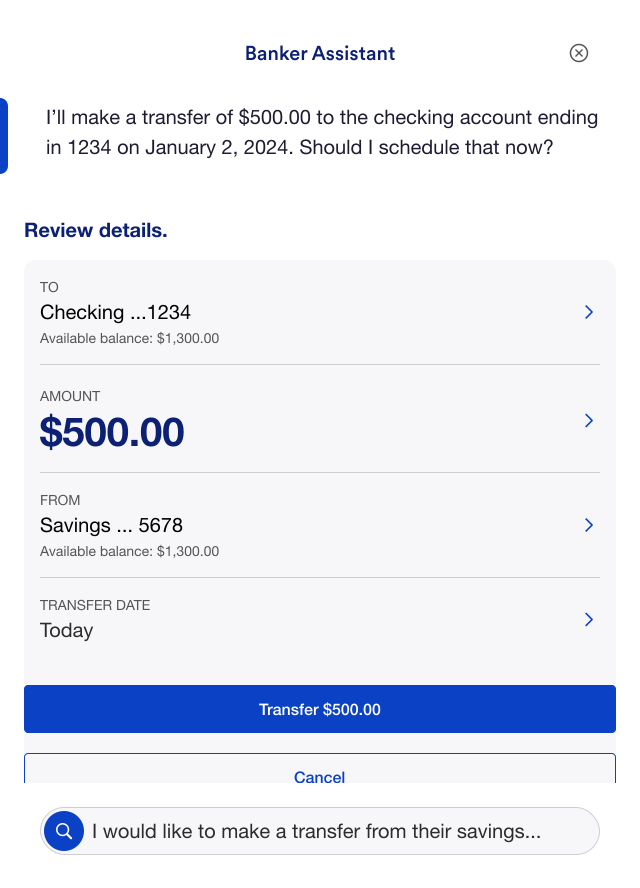 Review — the assistant restates exactly what it's about to do before anything happens.
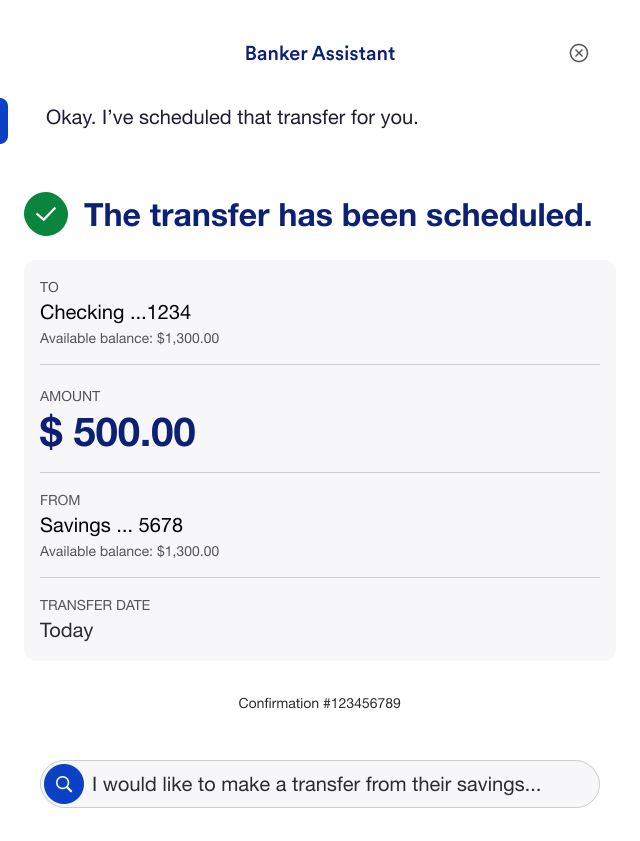 Confirm — a clear outcome state, with a confirmation number the banker can reference.
The goal wasn't maximum automation. It was reducing friction while preserving human judgment.
Financial-service AI needs to be helpful without appearing more certain or more powerful than it actually is.
What began as a customer-facing conversational interaction model provided a foundation for thinking differently about banker workflows too — less searching, more context, clearer next steps, and human control throughout. The banker experience adapted those same interaction principles around a user with more expertise, more responsibility, and a live customer relationship.
Designing AI for an expert is different from designing consumer self-service. The expert already understands the domain — the opportunity isn't to remove their judgment, it's to remove unnecessary work around that judgment. The strongest AI workflows don't remove the human from the decision. They remove unnecessary work around the decision.
I led product-design exploration for the Banker Assistant proof of concept, translating an established conversational banking model into banker-facing servicing workflows. My work included interaction-model definition, conversational flows, contextual information retrieval, guided actions, confirmation patterns, and edge cases — exploring how AI could fit naturally into an existing expert workflow rather than becoming another standalone tool.
Want to talk through this one?
Happy to walk through the research, the alternatives I ruled out, or how it shipped.